Even in the most successful homelessness prevention programs, referrals still have surprisingly challenging success rates. In LA County's Homelessness Prevention Unit, for every 2.2 attempted referrals from caseworkers, there is only one "successful" referral, which is defined as resulting in a participant enrolling in a new program or receiving a new resource.
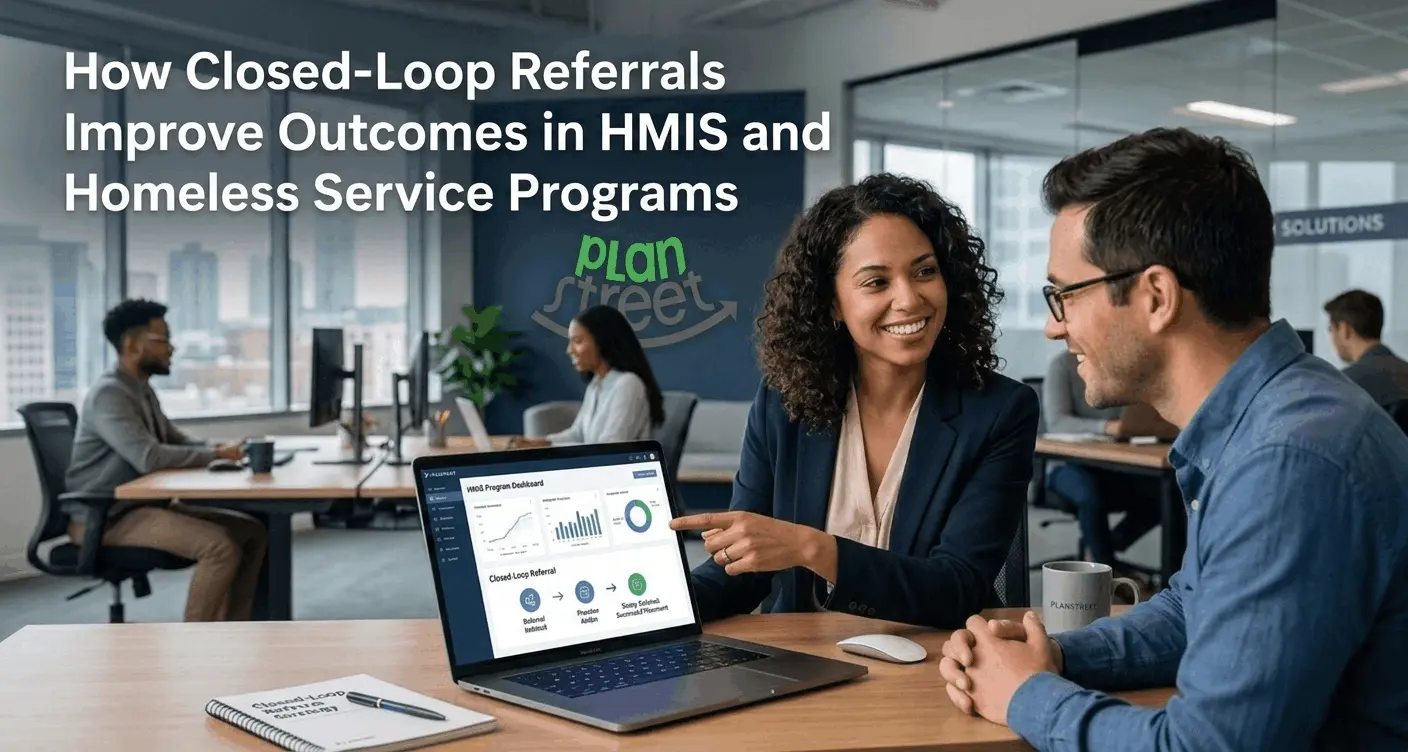
This example shows the need for social workers, HMIS administrators, and homelessness service providers to have more visibility over the completion of referrals. Case managers need automated capabilities to see the status of a referral after it has left their hands, so they can follow up and fix any problems that create barriers.
In this article, we'll dive into common problems with referral tracking and how closed-loop referrals in HMIS can be a cross-system fix.
Why Referrals Are Challenging in Homeless Services
People struggling with homelessness are in crisis. Any given night, they may not know where they are able to sleep. On top of that, they have to navigate a fragmented system that's trying to help more people than there are resources.
And it's no fault of nonprofit organization staff, who have to struggle with:
- Lack of cross-agency communication: There is no set platform for different providers to communicate with one another or view each other's progress, which leads to referral leakage.
- Manual follow-ups: Using phone or email takes up excessive time, with the average employee spending up to six hours a day managing their email.
- Spreadsheet version control issues: Information is scattered across HMIS, EHRs, spreadsheets, and point solutions, and many agencies can't see each other's updates.
- High caseloads: Case managers often carry high caseloads and dozens of open referrals, so sustained follow‑up on every warm handoff is unrealistic.
- Incomplete HUD reporting: When data is not fully documented, providers don't understand the scope of care needed for their clients.
These internal process issues lead to staff frustration and errors. When they don't have accurate homeless system collaboration tools needed to do their job correctly, clients are the ones who truly suffer.
What Referral Leakage Is Costing Housing Programs
Referral leakage is what happens when a person is referred to a housing or supportive service, but the connection never results in provided care. Instead, the referral "leaks" out of the system and never comes to fruition.
This leads to problems for housing programs, such as:
- Inaccurate performance metrics: When systems track "referrals sent" but not people actually housed, it gives a false impression of the program's success.
- Unmet needs: Reasons for referral failures help providers understand how to properly resource a system; if these aren't tracked, then they're never solved.
- Difficulty securing funding: Many nonprofits rely on grants, but if they can't attribute outcomes, it's difficult to win against stiff competition.
Why Traditional HMIS Systems Fall Short
Traditional HMIS systems were designed primarily for compliance reporting, not for real-time coordination. This makes it difficult to introduce modern workflows that multi-agency homelessness service providers need to work together to drive referrals.
They do not have the capability to track the metrics that HMIS administrators really need to assess the status of referrals, including:
- Referral success rate
- Time to housing
- Reasons for referral failure
These three are all key indicators for referral leakage.
What a Closed-Loop Referral System Looks Like
A closed-loop referral system in HMIS lets staff create a referral and track it across agencies in real time. They will always know how it ended, whether that be enrolled, housed, denied, a no-show, or any other event of your choosing. This eliminates referral gaps and helps your team measure leakage so they can get to the root of the problem.
This is what a closed-loop referral workflow can look like within an HMIS case management system.
1. Single referral record per person per need
A closed-loop system lets staff create one structured referral per person per need. This allows them to collect:
- Who is being referred
- What program they are being referred for
- For what service
- The reason they need the referral
This keeps all the information in one place and allows every provider to see the entire picture behind the "why."
2. Clear status lifecycle
Instead of a single "referred" checkbox, a closed-loop system tracks a full status lifecycle:
- Sent
- Received
- In-review
- Accepted
- Scheduled
- Enrolled
- Denied
- Waitlisted
- No‑show
- Unable to contact
Each status change is time‑stamped and tied to a user so teams can see, at a glance, where referrals are getting stuck. Plus, HMIS organizations can add additional status specific to their unique client clientele, creating a better system of communication.
3. Measured outcomes
In 2024, homeless response workers served more than 1.1 million people, a 12% increase from the previous year. The best way to assess that service is to collect measured outcomes, particularly for referrals that go to other agencies.
With a closed-loop referral, the referral is only closed when the receiving provider records an outcome and a reason. Capturing successful and unsuccessful outcomes turns referral leakage from a problem into something you can fix.
4. Tasks and alerts for staff
Closed-loop referral software that's combined with HMIS case management software gives staff a full picture of the client case. Automated alerts and reminders prompt actions such as "review within three days." If that's not done, then the system flags the task for the case manager to assess further.
5. Bidirectional partner visibility
Referring and receiving providers can see the referral and all the information attached to it, such as status and notes. Case management software that's secure can ensure that this follows HIPAA protocols, and that only relevant providers can gain access to the information.
This transparency supports warm handoffs, where the original worker stays involved to help the person navigate appointments, paperwork, and move‑in steps.
6. Built-in dashboards with real-time tracking
HMIS referral tracking systems like PlanStreet's usually come with analytics out of the box. This helps your team get started right away in assessing the most common reasons that referrals fail.
Segmenting your data by program, provider, or population helps leaders spot bottlenecks and equity gaps and adjust accordingly. Also, these update automatically whenever a team member makes a change, so that everyone always has the most relevant information.
Measurable Outcomes for CoCs and Housing Agencies
With closed-loop referrals in HMIS, you want to track measurable outcomes. This allows stakeholders and grant funders to see the valuable work you do, and helps keep teams compliant.
Data analytics can help you track:
- Referral completion rate: Share of referrals that result in enrollment or housing, not just "sent." This measures whether your referrals are successfully connecting people to help.
- Time from referral to housing: Average days from referral creation to key milestones. This ties closed-loop referrals to system goals around reducing time homeless.
- Referral fit/acceptance rate: Percentage of referrals that are accepted versus denied. This shows whether better workflows are reducing bounced referrals.
- No‑show rate: Portion of referrals that fail because the person never connects or disengages. Watching this tells you if warm handoffs and reminders are working.
- Equity in referral completion: Referral completion broken out by race, ethnicity, age, disability, and geography. This lets CoCs demonstrate that improved referrals are also closing equity gaps, not just overall numbers.
These five metrics can improve workflows within your organization and help you better serve every client.
What Housing Leaders Should Demand from Technology
As automation increases efficiency, nonprofit executive directors and housing leaders can implement game-changing software that reduces employee stress. When your team has tools to do their job faster, they're able to help more people.
When shopping for software for closed-loop referrals, be sure to ask about the following:
- End-to-end referral tracking: Your platform should follow a client from first contact through referral, enrollment, and housing placement, with every step visible.
- Automated referral status updates: The system should notify the referring and receiving providers when a referral is received, accepted, scheduled, or closed.
- Cross-agency collaboration dashboards: Should show how referrals flow across outreach, shelters, RRH, PSH, and mainstream partners. This gives at-a-glance views of bottlenecks, wait times, and outcomes across the ecosystem.
- Integrated HMIS and case management workflows: Case managers should be able to create, manage, check, and close referrals in the same system they use for enrollment, services, and case notes to prevent duplicate data entry.
- Real-time HUD and CoC reporting: Technology should help CoCs respond quickly to trends in access, equity, and housing outcomes, instead of waiting for annual reports.
When utilizing closed-loop referral software from PlanStreet, Equal Hope (a nonprofit organization dedicated to eliminating health disparities and improving health outcomes for women) saw a significant reduction in missed follow-ups and uncompleted referrals.
Improve Outcomes With Closed-Loop Referrals in HMIS
No coordinated entry software can promise that every referral is completed. However, it can promise that you'll know the reason why it wasn't. This kind of information is critical to improve your workflows and help clients who might have fallen through the cracks.
Explore PlanStreet's referral management capabilities, and if you have any questions, our team is available for a call at any time (no purchase required).