Just like many other businesses, healthcare organizations are struggling with rising costs. Hospital expenses increased by 7.5% in 2025, yet their prices were less than half of that. One of the hurdles to remedying the issue is the administrative burden. Hospitals spent $43 billion dollars last year on navigating claim denials, complicated paperwork (such as prior authorization and repeated documentation requests), and ever-changing billing and coverage rules.
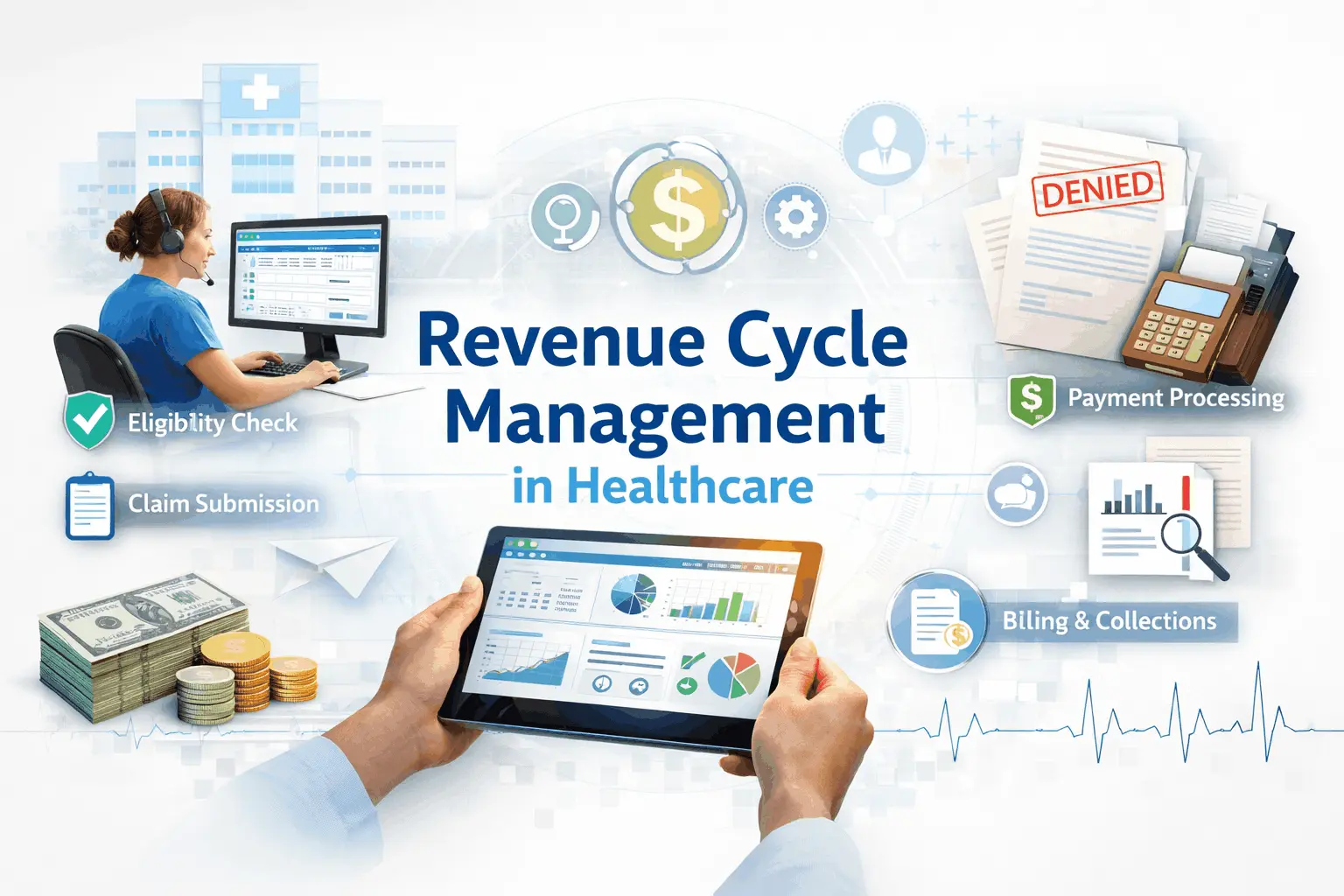
Healthcare organizations need digital tools that can automate these processes for them, allowing them to quickly bill insurance companies properly to avoid claim denials. Revenue cycle management software helps healthcare organizations streamline time-consuming manual processes, spending less money on their administrative work and more on their clients.
What Is Revenue Cycle Management in Healthcare?
Revenue cycle management (RCM) in healthcare is the end‑to‑end process that turns a patient encounter into a collectible payment for services.
RCM tracks every financial touchpoint in a patient's journey, from the moment they schedule an appointment until the account is paid in full or written off. It exists so that providers receive prompt payment for the care they deliver without leakage, delay, or avoidable write‑offs.
A typical RCM workflow goes like this, although it may differ depending on the setting:
- Registration: Collect personal details (such as demographics, contact info, etc.), insurance, and basic authorization needs before the visit.
- Insurance Verification and Authorization: Double-check coverage, benefits, and patient responsibility. Once you have that, get consents, and confirm the referring and ordering providers.
- Care Delivery and Documentation: Provide services while completing timely clinical documentation that supports coding.
- Charge Capture and Coding: Convert documentation into billable codes (CPT/HCPCS, ICD, modifiers) and create charges.
- Claim Submission: Submit clean claims to payers (such as Medicaid, Medicare, commercial, and MCOs) following payer‑specific rules.
- Remittance and Denial Management: Post payments and adjustments, correct denials, and resubmit or appeal the claim.
- Patient Billing and Collections: Bill patients for their portion, manage payment plans and financial assistance, and close out bad debt or charity.
Why Revenue Cycle Management Matters for Healthcare Organizations
RCM helps healthcare organizations operate with a regular cash flow, ensuring that each claim is properly submitted and the agency receives payment on time. By having a structured workflow, it minimizes the billing delays found so often in healthcare. On average, people who operate with a strong RCM keep the process to about 30-45 days, preventing financial stress on the organization and rising billing costs that come with overdue payments.
Some of the other benefits of revenue cycle management include:
- Improved Compliance: Healthcare billing software ensures that your coding and documentation match the requirements set by Medicare and Medicaid.
- Reduced Rate of Denied Reimbursements: Software safeguards claims by flagging errors or incomplete information before submitting.
- Increased Efficiency: Standardized workflow and task management keep every employee on the same page regarding which patients have been billed, with automatically updated dashboards allowing everyone to see the status of every invoice.
- Better Patient Experience: 70% of patients are confused by medical bills. With RCM, your clients see clear estimates and transparent bills, allowing them to see exactly what each service costs.
By stabilizing your revenue, effective RCM gives your organization the opportunity to invest back into itself with more resources for clinical staffing, new service programs, and updated technology.
Common Challenges That Lead to Billing Delays and Reimbursement Issues
Most of the healthcare revenue cycle management challenges that lead to billing delays stem from manual processes. When administrative personnel are typing in details by hand, printing out forms for clients to fill out, or referencing code manually, then it's more likely that claims will have an error. Administrative costs from issues like these account for up to 25% of US health expenditures.
Additionally, a patient shouldn't be assumed to be covered just because they have been seen at a practice previously. Healthcare administrators must regularly verify insurance to ensure that the patient is covered before providing service, or else they risk denied claims.
Plus, Medicaid and Medicare requirements are constantly changing. Without an automated system to check what's required on your team's behalf, it is nearly impossible to remain compliant.
5 Ways Revenue Cycle Management Software Improves Billing Workflows
Revenue cycle management software improves billing workflows by automating routine steps. This reduces errors and gives staff real‑time visibility into where money is stuck at each stage of the revenue cycle. With this information, leadership has more accurate data and can make better decisions for the organization as a whole.
Here are five ways revenue cycle management software changes the game for billing workflows.
1. Cleaner Front-End Speeds Up the Billing Process
Automated insurance verification runs eligibility checks in real time at scheduling and check‑in. This prevents claims from going out with inactive coverage or information. This means clients can be seen faster, and your team doesn't have to remember to do this themselves, removing opportunities for costly errors.
2. Automated Claim Creation, Scrubbing, and Tracking Reduces Manual Work
Claims are automatically built out from information collected at intake using case management software. Then, it uses payer-specific rules and edits the claim before submission if required. Staff can review before submission to ensure that every detail is correct. However, the software can catch common errors and fix them, such as:
- Missing modifiers
- Invalid code combinations
- Required fields
This built-in buffer reduces rejection rates and helps your organization collect cash more quickly.
3. Streamlined Submission, Posting, and Follow‑up
If your team struggles with too many tabs, RCM software solves that problem. You can electronically submit to multiple payers at the same time, no longer dealing with paper claims or five different portals. Staff don't have to stress about keying every line item because electronic remittance posting (ERA) automates payment posting and adjustments. Instead, the admin can focus on exceptions and denial management.
Sometimes, it can be challenging for workers to understand who is supposed to follow up on each bill. Work rules route denied or underpaid claims to the right staff with standardized workflows, so follow‑up is consistent.
4. Integrated Patient Billing and Payments Accelerates Collections
With reimbursement management software, patient statements, reminders, and payment plans operate the way that's best for your clients. They can be generated and sent via text, email, or the client portal, allowing the client to choose their preferred method. Payment options such as Stripe, PayPal, and Square can be integrated into the same system, streamlining the whole process.
Staff no longer have to spend hours on phone follow-ups; instead, the software sends automated reminders if a client is past due.
5. Analytics With Better Data Allows for Continuous Improvement
Every organization benefits when workflows go more smoothly. To improve reimbursement in healthcare, your team needs analytics that collect the data from your RCM. This allows your team to assess gaps and see what's stopping billing processes from completion.
Some of the most helpful metrics your team can measure using built-in reporting software include:
- Days in A/R: Average number of days it takes your organization to get paid after charges are posted.
- Denial rate by payer: Percentage of claims a specific payer rejects or denies out of all claims you submit to that payer for a period.
- Clean claim rate: Percentage of claims that are accepted by the payer on first submission without needing corrections, additional information, or resubmission.
- Collection rate: Percentage of expected reimbursement that you collect after contractual adjustments and write‑offs.
Leaders can see patterns, such as eligibility denials all stemming from one clinic, and adjust workflows, templates, or payer rules as needed directly in the system.
Key Features to Look for in Revenue Cycle Management Software
Choosing the right partner is key when selecting your software. When you're researching options and scheduling demos, use the checklist below to assess if it offers all of the features that your organization needs.
- Eligibility and Benefits Verification: The software should be able to verify these on your behalf.
- Authorization Management: Your team should be able to track and manage prior authorizations.
- Centralized Client and Billing Data: Both facets should be in one single location to simplify administrative needs, tying documentation to services.
- Workflow Automation: Allows your team to customize tasks with repeatable templates and automatic assignment of work.
- Denial Monitoring: Your team is automatically updated on denials, and analytics help assess the root of the problem.
- Payment Posting and Reconciliation: Accurate tracking of reimbursements and outstanding balances.
- Audit-Ready Reporting: Every action is automatically tracked, so your administration is always prepared for a Medicaid or Medicare audit.
- Compliance Support: Software automatically updates to meet the most recent compliance requirements, ensuring your team is always compliant.
Improve Revenue Cycle Management Workflows With PlanStreet
As budgets continue to tighten in healthcare, your clients don't have to be affected as long as you're improving workflows. PlanStreet's Revenue cycle management software offers all the features listed above, helping your team centralize operational data, improve documentation consistency, automate workflows, and support reporting visibility.
Learn more about our comprehensive software and schedule a free demo with our team today.
Frequently Asked Questions
Billing delays usually stem from manual processes and data gaps. Common errors include incomplete or incorrect registration data, missing documentation, eligibility problems, coding errors, disconnected clinical and billing systems, and backlogs in review and follow‑up. Each delay compounds, pushing claims closer to timely filing limits and slowing cash flow.
Reimbursement is delayed when claims are sent out as incomplete or incorrect. Denied claims, missing or inaccurate information, prior authorization gaps, and basic submission errors all force rework before a payer can process payment. Limited understanding of claim status and weak denial‑management workflows mean issues aren't fixed quickly, so payments sit in limbo instead of being resolved.
RCM software standardizes the steps between care delivery and payment. It enforces documentation requirements, improves coding accuracy, and builds clean claims using payer rules. Automated workflows and task queues speed follow‑up on denials and claims. Real‑time tracking and dashboards help staff see where money is stuck. Together, these capabilities reduce delays and increase collected revenue.
Core RCM KPIs include: days in A/R (how quickly you get paid), clean claim rate (claims paid on first submission), denial rate by payer, and net collection rate (how much of the allowed reimbursement you actually collect). Many organizations also track bad‑debt and write‑off rates, cost to collect, and lag days between service, coding, billing, and payment to spot bottlenecks.